

Firstly, I hope you are having a great April and staying safe out there!
If you could take a few minutes to read BOTH articles, I really think this edition is of high value to everyone.
In this month’s newsletter we will be looking at;
-
- How your ability to earn is actually your greatest asset, and
- Providing useful tips regarding replacement insurance
What is your long term income worth?
Your ability to earn is by far one your greatest assets

Many of us have been asked the question: what is your greatest asset? And the answer in our industry is of course – your ability to earn an income.
Let’s remove our bias however, and take a look at the numbers by logic, not emotion.
Family / Investment Home
Let’s say that your home is in Auckland, where the average house price in November 2017 was $1M (including the value of the land). This will vary depending on location, but to keep things simple, let’s say $1M.
I am going to make some calculations based on a property we have randomly selected that sold in October 2017 for a little over $1,010,000 in Unsworth Heights, North Shore City.
The property is 170 SQM in Floor area and would cost about $2500 per square metre to replace (i.e if the house burnt down) which is $425,000.
The insurance premiums would be $90 per month. Remember these figures.
Income Comparison
Let’s look at what your earnings are now and what you could earn over your lifetime. In the same month and year as the home we used above, the average household income in Auckland was $120,000.
Not allowing for inflation or any increase at all in pay, the amount you would earn over ten years would be $1.2M, so 20 years would be $2.4M and 30 years would be $3.6M.
Remember, I have not allowed for any other factors that would increase your income or your property value.
Let’s assume that you are aged 45 now and you will work 20 more years until retirement. You would earn another $2.4M and the premium to insure this potential income would be approximately $167 per month.
Based on receiving a replacement income of $7,500 per month every month for 20 years with no inflation adjustment, this would equate to $1.8M in income.
So based on a premium for $167 per month, to potentially receive $1,800,000 for being off work long term due to an illness, versus paying $90 per month to receive $425,000 if your house burns down or there is a natural disaster for example, why would you then not make sure the $1,800,000 is properly protected?
What is your greatest asset now?
Have a read over those numbers above and decide for yourself.
We Kiwis LOVE our real estate. We love something tangible, brick and mortar, something we can drive by, walk into, smell and see, but all that goes out the window when our ability to earn stops and we have lost our ability to create an income.
Just trying to put into perspective how important it is to insure your ability to earn an income.
Protect what you have, you’ve worked hard for it!
We work so hard to better our lives for ourselves and our family, that we sometimes do not stop and take stock of what our greatest assets are and what the impact would be if we lost that asset.
How long did it take you to gain your experience and become valuable in your occupation? For some of us, we have invested decades into our profession, only to neglect a backup plan, if we could not work again.
Insurers recognize the value of our incomes, which is why you can buy Income Protection insurance (or other similar products depending on your situation).
If you have not yet protected one of your greatest assets – that could be millions of dollars, then you need to contact us today.
1. Premiums based on Male, Non-Smoker, Age 45, Occupation Class 2, Wait Period 13 Weeks, Benefit Period To Age 65, Insure for $7,500 per month with CPI Increases, Agreed Value.
For your own protection
What you should know when replacing existing insurance.
Have you ever been approached by a bank teller or another adviser offering to review your cover and maybe even save some money on premiums? I am all for saving money on premiums and discussing protection, but there is a process to follow to make sure you are not disadvantaged.
Here is what you need to know if this happens
Replacing insurance cover with an alternative cover may be what you need, especially if you have not reviewed your insurance cover for a long time.
I came across a case recently where a bank teller offered a client a cheaper premium that provided Life Cover and Trauma Cover but made no attempt to understand her needs and what she currently had.
Without hesitation, the teller replaced the client’s current cover with bank cover that was far inferior to what the client currently had. There were so many benefits the client had with her current cover that she did not get with the new bank cover, but the client was never told that by the bank staff, so the client was none the wiser.
To be fair, this was not the client’s fault, as far as she was concerned insurance is insurance.
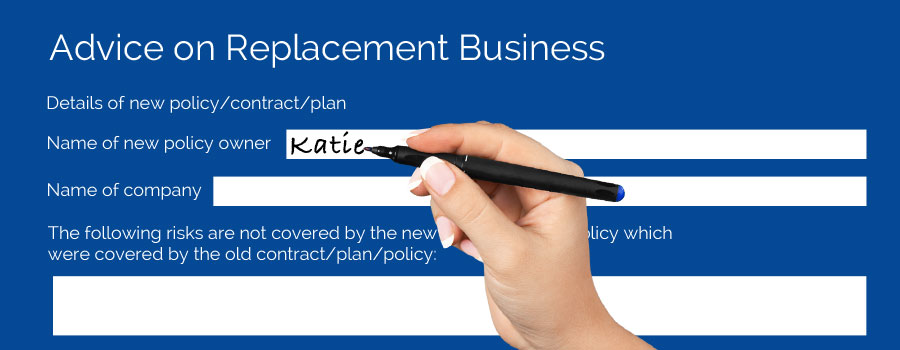
Advice on replacement business
It irks me to see a business practice that disadvantages the client, but this will only become obvious until claim time when the fine print kicks in.
When it comes to replacing existing insurance business, our adviser industry adheres to a much higher standard of rules and disclosure to our clients. We need to make sure we work in their best interests. The client must know exactly what they are applying for, and we must also highlight what our clients may be missing out on, if they took out a new policy to replace an existing one.
What to do when you get asked
It’s best just to say “No thanks, I have an adviser” and contact us so we can review your current cover.
However, if you ever find yourself in a situation like this, you need to ask them to give you an “Advice on Policy Replacement” document that will tell you in writing of any cover you will miss out on if you take out new cover to replace your existing cover.
If they are not prepared to give you this, then it’s not worth anything and walk away.
What happened to a client
When I met with her and her husband and showed them the differences between what her current cover was and what the bank cover was, she was not very happy at all. She cancelled her bank cover and reinstated the insurance cover I had arranged for her.
The smaller premium savings were not worth the trade off, of losing so many other benefits. Now I have a happy and educated client.


